


| Issue |
Knowl. Manag. Aquat. Ecosyst.
Number 427, 2026
Biological conservation, ecosystems restoration and ecological engineering
|
|
|---|---|---|
| Article Number | 6 | |
| Number of page(s) | 12 | |
| DOI | https://doi.org/10.1051/kmae/2025034 | |
| Published online | 05 February 2026 | |
Review Paper
Insights from a nation-wide environmental relicensing of hydropower facilities in Sweden: a review of court verdicts from a biological perspective
Swedish University of Agricultural Sciences, Department of Aquatic Resources, Stångholmsvägen 2, SE-17893, Drottningholm, Sweden
* Corresponding authors: This email address is being protected from spambots. You need JavaScript enabled to view it.
; This email address is being protected from spambots. You need JavaScript enabled to view it.
Received:
16
November
2025
Accepted:
21
December
2025
Abstract
Hydropower, utilized for centuries, is promoted globally as renewable energy. The many ecological costs associated with hydropower facilities can be mitigated, but the perceived socio-economic benefits often outweigh environmental concern. The EU Water Framework Directive (WFD), implemented in 2000, established a framework for community action in the field of water policy. It constitutes an instrument to compel hydropower facilities to align with environmental requirements. Based on the WFD and national law, a National Plan for Modern Environmental Conditions for Hydropower (NAP) was formulated in Sweden to renegotiate the environmental permits of around 2000 hydropower plants and dams. The NAP process commenced in 2022 and is estimated to last approximately 20 year. In this review, we assessed the 33 court cases completed until the end of 2024, out of which 22 resulted in permit withdrawal and dam removal, while 11 received decisions requiring remedial measures. The primary focus of remedial measures was re-establishing longitudinal connectivity; other environmental aspects received less attention, and monitoring requirements were almost non-existent. We recommend measures using adaptive design, prioritizing functionality, and monitoring over detailed technical specifications. In addition, greater attention should be given also to aquatic habitats in affected reaches: addressing e.g., flow, water levels, and temperature. In conclusion, this nation-wide process provides a unique opportunity to implement measures that could benefit entire riverine ecosystems.
Key words: Dam removal / environmental law / fish migration / hydroelectric production / river connectivity
© J. Sundin et al., Published by EDP Sciences 2026
 This is an Open Access article distributed under the terms of the Creative Commons Attribution License CC-BY-ND (https://creativecommons.org/licenses/by-nd/4.0/), which permits unrestricted use, distribution, and reproduction in any medium, provided the original work is properly cited. If you remix, transform, or build upon the material, you may not distribute the modified material.
1 Introduction
Hydropower facilities and their associated dams and reservoirs have contributed energy to human society for centuries, initially on a local scale in the form of e.g., mills and later at much larger scales after the development of hydroelectric plants (Almeida et al., 2022). Hydroelectricity is globally promoted as a renewable resource, but ecological costs are often high (He et al., 2024; Nyqvist et al., 2025). Impoundments upstream of dams turn river rapids into lake-like environments and downstream sections have altered flow- sedimentation- and physico-chemical dynamics impacting the river ecosystems (He et al., 2024). For mobile organisms like fishes, dams block up- and downstream movements, in effect fragmenting both habitats and populations, leading to population decline or even local extinction of migratory species (Jonsson et al., 1999; Limburg and Waldman, 2009, Algera et al., 2020; Nyqvist et al., 2025). Importantly, similar issues can apply to relatively resident species, which need to move in relation to changed environmental conditions and disperse to maintain genetic diversity (Jones et al., 2021; Schiavon et al., 2024). On a global scale, dams are considered to be a threat to almost 4000 aquatic, semi-aquatic, and terrestrial species (He et al., 2024). A variety of measures have been implemented to mitigate the ecological effects of hydropower. This includes various fish passage solutions (Katopodis and Williams, 2012; Silva et al., 2018) which initially were focused mainly on aiding upstream passage of salmonids, but later also cover two-way passage of whole fish communities (Mallen-Cooper, 1999; Calles et al., 2013a). Other measures relate to flow regulation effects, which can be mitigated by implementing multifaceted natural flow variability (environmental flows, or “e-flow”) (Richter et al., 1997; Poff et al., 2010; Acreman et al., 2014). A main concern related to environmental flow is lost power production, but models indicate that the annual loss need not be substantial (Widén et al., 2022b), although regulatory capacity might be reduced. In practice, however, regulation on minimum flow is more commonly applied than environmental flows (Arthington et al., 2006; Malm Renöfält et al., 2010), despite the riverine ecosystems’ dependence on natural and seasonal variation in flow magnitude, rate of change, frequency, duration, and timing (Poff et al., 2010; Acreman et al., 2014). For temperature- oxygen- and gas supersaturation effects, remedial measures are available but seldom implemented (Poole and Berman, 2001; Li et al., 2022). Relating to all mitigation measures at hand, monitoring and evaluation of the applied measures in combination with adaptive management based on such evaluations is required for successful mitigation performance (Birnie-Gauvin et al., 2017; Nyqvist et al., 2017).
In Sweden, the usage of water for energy generation dates back many centuries, supplying e.g., mills, triphammers, and saws through waterwheels, often fed from small dams (Fryxell et al., 1931; Swedish National Heritage Board, 2021). The first Swedish hydroelectric plant was constructed in 1882; a small-scale private plant at Rydal in the river Viskan (Perers et al., 2007). A quick expansion of private and municipal hydropower plants followed in the late 1800’s and early 1900’s (Fryxell et al., 1931). Large-scale production plants were inaugurated in the 1910’s at the advent of state-owned hydropower (Olidan in the river Göta älv in 1910, Porjus in the river Luleälven in 1915, and Älvkarleby in the river Dalälven in 1917, Fryxell et al., 1931; Ödmann et al., 1982; Perers et al., 2007). The main construction period lasted between 1910 and 1970’s, with a culmination from 1940’s to 1960’s in association with the development of the national power grid which made production in the north accessible to the rest of the country (Ödmann et al., 1982; Perers et al., 2007; Lindström and Ruud, 2017). Construction levelled off when the potential for further large-scale development became limited without causing deterioration to the last few free-flowing large rivers, with associated critique from environmentalists (Arheimer and Lindström, 2014; Köhler and Ruud, 2019). This hydroelectric development has resulted in a present-day state where Sweden has around 2000 dams associated to hydroelectricity production (Lindblom and Holmgren, 2016).
Historically, the perceived socio-economic benefits of increased energy production outweighed environmental concern, which is reflected in the existent (legally bound) operational permits, or the lack thereof in some cases (Ödmann et al., 1982; Lindström and Ruud, 2017; Schäfer, 2021). Indeed, hydropower plants often operate under original permits that have remained valid without re-evaluation under modern environmental laws (Svensson, 2000). Consequently, in Sweden, hydroelectric production has historically faced fewer environmental mitigation requirements than other industries (Schäfer, 2021). Even if some history writers have claimed that no serious criticism was raised against the negative environmental effects until the mid-1900’s (Ödmann et al., 1982; Jakobsson, 2002), this perspective likely overlooks silent or silenced opposition to river regulation; not the least the experiences and opinions of the indigenous Sámi, who endured land appropriation, forced relocations, loss of water access, destruction of reindeer grazing lands, and other major environmental changes in their homelands associated to with early large-scale hydropower development (Össbo, 2023a, b).
In 2019, Swedish environmental law was updated to require hydroelectric plants to comply with modern environmental legislation (SFS 1998:808, chapter 11, §§27-28, updated by SFS 2018:1407). Importantly, the EU Water Framework Directive (2000/60/EC) was implemented in 2000, which established a framework for community action in the field of water policy. Based on this directive, and the legal update, the Swedish government tasked the Swedish Agency for Marine and Water Management (SwAM), the Swedish Energy Agency, and Svenska Kraftnät (the authority responsible for Sweden’s electricity transmission system) with coordinating efforts to modernize environmental conditions of hydropower facilities (SwAM et al., 2019). A National Plan for Modern Environmental Conditions for Hydropower (NAP) was later formulated to renegotiate the environmental permits of all hydropower facilities with permits older than 40 yr (Swedish Government, M2019/01769). This large-scale process, covering almost all of Sweden’s hydropower plants and dams, was decided upon by the government in 2020 and commenced in 2022 and is estimated to take approximately 20 yr. It involves re-licensing each plant through Environmental Court negotiations, preceded by a collaborative process including powerplant owners, authorities and interest groups, to align with current national and EU legislation. To safeguard electricity production and grid balance, key facilities will face less stringent requirements (Swedish Government, M2019/01769). Operators who find modernization too costly may choose to cease operations and remove associated dams (Swedish Government, M2019/01769). The NAP work has, however, not progressed undisturbed. In December 2022, the Ministry of Environment decided to pause the process, initiating a 12-month suspension on January 30, 2023 (Ministry of Environment, M2022/02251). The Ministry of Climate and Enterprise has since then extended the pause several times, with the latest extension lasting until July 1, 2025 (SFS 2024:285), and the process was restarted in August 2025. Due to Sweden’s non-compliance with the Water Framework Directive, the European Commission launched an infringement procedure in December 2024, issuing a formal notice [INFR(2024)2236]. The NAP process hence constitutes an exceptional case study where energy production needs are weighted against environmental protection via national and international environmental law and directives.
Fewer than 40 re-licensing court trials had been completed within the NAP process until the end of 2024. Nonetheless, several issues have already emerged, including conflicts between electricity production and environmental considerations, fairness in trials, and uncertainties around water-body definitions and classification, ensuring best-practice measures, and monitoring of functionality and effects of prescribed measures (e.g., County Administrative Boards, 2022; Lenvin, 2022; Government Offices of Sweden, 2024; Pettersson and Bladh, 2024; Sandberg, 2024). This underscores the significant need for information and knowledge ahead of the remaining retrials. Here we evaluate the court verdicts completed so far, focusing on those with legally binding requirements for remedial measures. We summarize the listed measures and monitoring obligations, with particular attention to the European eel, Anguilla anguilla, given the high importance of up-and downstream connectivity for this species, and since it is critically endangered (Pike et al., 2020). Gaps in the requirements are identified, and we provide recommendations for measures and monitoring to be included in future retrials.
2 Review of court decisions
2.1 Data extraction
In Sweden, all court decisions are public due to the principle of public access to information (SFS 2009:400; Riksdag of Sweden, 2009). The court decisions on the re-licensing of the environmental legal conditions for hydropower plants can hence be requested and accessed by anyone. We identified completed retrials via the web application “Strömmen”, provided by the Swedish Agency for Marine and Water Management (SwAM, 2024). For the 33 retrials that had been completed until the end of 2024 (i.e., before the onset of the pause, only counting decisions that cannot be overruled, in Swedish: har vunnit laga kraft), the court decisions were obtained by requesting them from the respective courts. The decisions were requested and received via email in Portable Document Format (.pdf). From Strömmen, the following information was extracted: name of hydropower facility, river, court case number (if applicable supreme court number), court name, decision (retraction of permission – i.e., removal of facility, or granted to continue with modern environmental conditions). From the court verdicts and related discussion in the document, the following information was extracted: capacity of the hydropower plant (Q), hydropower plant effect/power (in kilowatt, kW), mean annual flow of the river (MQ), mean low flow of the river (MLQ), upstream passage solutions, downstream passage solutions, requirements concerning type of guidance, maximum angle of rack (in cases where the type of guidance was an inclined [alfa rack] or angled [beta rack]; Harbicht et al., 2022), maximum gap width of rack (in cases where the type of guidance was an inclined or angled rack), discharge through downstream bypass, eel ramps (yes/no), type of fishway, required slope of fishway, flow in fishway, hydropeaking restrictions, e-flow requirements, and monitoring requirements. To obtain specific data related to the European eel, the words “ål”, “ålen” and “ålyngel” (i.e., eel, the eel and eel elvers in Swedish) was searched for in the court verdicts. In what context eel was mentioned was noted, and other relevant comments in relation to context were also noted. Information on measures and monitoring was extracted from the court verdicts or the comments on the court verdicts, and, while sometimes complemented by information provided elsewhere, the discussions leading to the verdict were not taken into account.
Of the 33 completed cases, 22 resulted in permit withdrawal and dam removal (Fig. 1). In the remaining 11 cases, the court allowed continued hydropower production, contingent on meeting modern environmental conditions listed in the verdict (Fig. 1). Ten of these are small-scale plants (<1.5 MW), and one is a regulation dam for downstream hydropower (Tab. 1). All verdicts emphasize longitudinal connectivity and fish passage, requiring downstream fish passage solutions; 10 of 11 also mandate improved upstream passage (Tab. 2, and see “passage” subheading). Environmental flow received less attention, though most verdicts include minimum flow requirements through fishways and some restrict hydropeaking (Tab. 2, and see “flow” subheading).
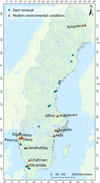 |
Fig. 1 Map of Sweden showing all 33 completed court case locations. The 22 facilities with withdrawn permits (dams to be removed) are indicated with blue points. The 11 facilities granted continued hydropower production (conditional on meeting modern environmental standards) are indicated with red triangles, with each facility labelled by name. |
Descriptive data for the 11 facilities granted continued hydropower production (conditional on meeting modern environmental standards): name of the facility, river catchment, court, court case number, water flow of the hydropower plant (Q), effect of the hydropower plant (in kilowatt, kW), mean annual flow of the river (MQ), and mean low flow of the river (MLQ). Missing information in the court decisions is denoted not provided (NP). Note that Kaserna is a regulation dam and not a hydropower facility (hence, water flow and effect is not applicable (NA) at this site.
Descriptive data for the 11 facilities granted continued hydropower production (conditional on meeting modern environmental standards): name of the facility, requirements concerning type of guidance, maximum angle of rack (in cases where the type of guidance was an alfa or beta rack), maximum gap width of rack (in cases where the type of guidance was an inclined or angled rack), amount of water discharge through bypass, eel ramps (yes/no), type of fishway, required slope of fishway, flow in fishway, minimum flow, restriction against hydropeaking (No peaking), and requirements to change turbine discharge at a slow rate (Reduced rate). Missing information in the court decisions is denoted not provided (NP). Note that Kaserna is a regulation dam and not a hydropower facility (hence, water flow and effect are not applicable (NA) at this site.
2.2 Downstream passage measures in the court decisions
Guidance screens and associated bypasses are required at nine of the 11 facilities (Tab. 2). Among the required guidance screens, four are inclined (i.e., guiding the fish vertically towards the water’s surface: alfa rack), one is angled (i.e., guiding the fish laterally towards one side of the river/channel: beta rack), and four are undefined (Tab. 2). Maximum angles against the flow are 30°(n=2), 35°(n=6), and 45°(n=1), while maximum gap widths are defined as 13 mm (n= 1), 15 mm(n=2), or 18 mm (n=6 ) (Tab. 2). Bypass pipes leading fish downstream are required together with the rack at all facilities except at Fada, where eels are to be trapped in a traditional eel trap (in Swedish: ålkista) and transported downstream past the dam (transport of other species is not mentioned). One facility requires an overlay plate for velocity refuge by the end of the rack (Lingforsen). At one facility, the lack of such plate is explained by low water velocity making it redundant (Ellenö). For six facilities where guidance racks were required, bypass discharge is defined, ranging 30−220 L s−1. Based on turbine capacity stated in the verdicts, this corresponds to a median of 5.2% (range =1.5−20%, n=6) of the maximum flow through the rack itself. Two facilities did not require guidance screens: Kaserna and Kengis bruk. The facility Kaserna, being a regulation dam, does not have a turbine but regulates flow for downstream hydropower plants and therefore the court presumably assumes that fish will safely pass through the only route available. At Kengis bruk, the dam does not cover the full width of the river, and remedial measures to improve downstream passage include reducing the width of a temporary dam, closing the power plant for two weeks during peak salmonid smolt migration (closure triggered by either temperature increases or peak flow), and running the power plant with open sluice gates next to the turbine intake through the bulk of the smolt run (other fish species are not mentioned).
2.3 Upstream passage measures in the court decisions
At all facilities except Kengis bruk (where the dam does not span the full river width), some type of upstream passage solution is required (Tab. 2). This includes fishways that allow the entire fish community to pass, or at least a large part of it (n=6), or eel ramps for juvenile eels (n=6) (Tab. 2). Two verdicts require both an eel ramp and a technical fishway (Tab. 2). Where only eel ramps are required, this is based on assumptions that naturally this reach would only be passable for eel.
Among the required fishways, four are nature-like and two are vertical slot fishways, (Tab. 2). Slopes for nature-like fishways range from 1.2% to 4% (Tab. 2), while the vertical slot fishway has a maximum drop of 15 cm and a slope of 5−7%. Where specified (n=3), water discharge to the fishways range from 50 to 330 L s−1 (Tab. 2), or 5% to 17% of the river’s mean annual flow (MQ). One of the eel ramps requires the downstream bypass pipe to exit near the ramp to provide additional attraction water.
The operation period is defined for three fishways and five eel ramps. Fishways must function year-round, except for one site where winter conditions (e.g., ice cover) exempt operation. Eel ramps are mandated to operate from May (n=4) or June (n=1), to end of September (n=2) or mid-October (n=3). For three facilities (Lingforsen, Ellenö, and Stigen Västra), operation periods may be adjusted in consultation with the County Administrative Board (i.e., the supervisory authority). For the facility Stigen Västra it is further specified that based on climate change and/or new knowledge, operation period adjustments may be needed. In addition, for three facilities (Ellenö, Stigen Västra, Kaserna), it is specified for what eel sizes the ramp shall function for (10–40 or 0–70 cm).
Fishway placement is detailed in some verdicts, while others require the final setup to be determined in consultation with the County Administrative Board or a fish passage specialist. At one facility (Lingforsen), a chain barrier is prescribed to guide fish from the tailrace to the bypassed river where the fishway is located. At another facility (Husbykvarn), an additional fishway is required to connect the tailrace to the area downstream the spillway, where the primary fishway is situated. At one site (Kärramölla), the power plant must shut down one day per week from September to October to facilitate upstream migration (attraction to the fishway) of salmonid spawners.
2.4 Flow and habitat measures in the court decisions
Hydropeaking (i.e., short term shifts in turbined discharge to track electricity demands or prices, in Swedish: korttidsreglering) is explicitly prohibited in six verdicts, while two verdicts mandate reduced rates of change in spilled or turbined flow without specifying thresholds. Despite most dams having bypassed river reaches of different lengths, minimum flow is typically just a consequence of discharge in the fish passage solutions. Mandated minimum flow range from 5 to 610 L s−1 (Tab. 2) or the river discharge. Mean annual flow (MQ) and mean low flow (MLQ) are available in the verdict background material for nine facilities. For these, the median environmental flow constitutes 10% (range: 3−17%) of the mean MQ, or 100% (range: 50−131%) of MLQ. Dynamic or adaptive environmental flows are not mentioned in any verdicts. Downstream habitat restoration to facilitate fish movement is required in three cases (Lingforsen, Kärramölla, and Ellenö). No other habitat measures are mentioned in any verdicts.
2.5 Monitoring in the court decisions
Monitoring requirements in the court verdicts for actions implemented to fulfil modern environmental conditions are limited. For most facilities, monitoring requirements only concern registration of water discharge, or confirming water discharge in fish passage solutions. Evaluation of the function of remedial measures is only required in a few verdicts (Fada, Skeppsta, Kaserna, and Kärramölla). At the facility Fada, the functionality of up- and downstream passage facilities should be confirmed using the best available monitoring technique during the first 3 yr post-implementation. This verdict also allows adjustment if conservation status targets (in Swedish: bevarandestatus) or environmental quality standards (in Swedish: miljökvalitetsnorm) are not met in accordance with relevant legislation (i.e., the implementation of the EU Habitats directive (92/43/EEC) and Water Framework directive (2000/60/EC) in the Swedish Environmental Code). At the facility Skeppsta, a statement of functionality from an expert is required, but the basis for the statement is not defined. At the facility Kaserna (the regulation dam), evaluation of the functionality of the fish passage solution is also required, again without specifying what the evaluation should contain. For the facility Kärramölla, the regulatory authority should advise on the evaluation of passage solutions. Regarding eel ramps, monitoring is only mentioned for one facility (Lingforsen) where the eel ladder should be checked weekly, no additional information is given in the verdict.
2.6 Withdrawal of permit and dam removals in the court decisions
Of the 33 retrials completed so far, 22 led to dam removal (Tab. 3). These cases fall outside of the main scope of this study. Monitoring post-removal-effects is however important to understand ecosystem responses, and we therefore present data on dam removals in short. Seven facilities were small scale (effect below 1.5 MW), which is within the same range as those that were granted permission for continued hydropower production (Tab. 1), and the remaining 15 were listed as having “unknown” effect (some of which were dams, not hydropower plants) (Tab. 3). One dam could not be found in the field, not even remains of it, (Damm vid Småvatten M 580-22, Tab. 3). All verdicts list some form of restorative and/or habitat enhancing measures.
Descriptive data for 22 facilities where the retrial led to dam removal: name of facility, river catchment, court, court case number, effect of hydropower plant (unknown or small scale <1.5 MW). Note that some facilities are dams and not hydropower plants.
3 Discussion
Since the start of the retrials within the National Plan for Modern Environmental Conditions for Hydropower in 2022 to the first pause in 2023, a total of 33 cases have been completed (until the end of 2024, counting decisions that cannot be overruled). Of these, 11 facilities were granted continued hydropower production, conditional on fulfilling modern environmental conditions. The remaining 22 cases resulted in permit withdrawal and dam removal. All verdicts focus on longitudinal connectivity and fish passage and are based on present species distribution and environmental conditions. When mentioned, monitoring requirements focus mainly on abiotic factors (e.g., flow in fishway), with only a few verdicts formulating requirements based on function or ecological effects of remedial measures.
3.1 Downstream passage and guidelines
Given the historical relative absence of downstream passage solutions in Swedish rivers (Calles et al., 2013), it is encouraging that most verdicts include specific protection and guidance systems to allow downstream passage of fish. Nine verdicts require low sloping racks with small gap-widths to hinder fish from passing through turbines and guide them to a safe route. Versions of such solutions have proven effective for eel (Calles et al., 2021; Tomanova et al., 2023) and juvenile and adult salmon (Nyqvist et al., 2017, 2018; Tomanova et al., 2021). Gap width (Harbicht et al., 2022) and angle (Albayrak et al., 2020) are important characteristics to the guidance rack function. In the assessed verdicts, gap-widths and sloping angle ranged between 13−18 mm 30−45°, respectively. Calles et al. (2013) defines best available technique as gap-widths of 10−13 mm and angles ≤30°, but the authors do not exclude good performance at slightly larger gap-widths and greater angles. Indeed, good guidance has been reported for gap widths of 15−20 mm, and angles of 26-30 (Calles et al., 2021; Tomanova et al., 2023). Guidance performance also depends on features like overlay plates and bypass entrance design (Albayrak et al., 2020), which at times can result in low guidance performance (de Bie et al., 2018). Also, fish sizes up to 20-times the gap-width can pass through these racks (Knott et al., 2023), however, this likely varies between species due to differences in body shape. Therefore, given the technical specifications defined in the verdicts, good guidance performance is possible but should not be assumed for all species of fish.
3.2 Upstream passage vs. guidelines
Upstream passage solutions adapted for the entire fish community are only required at sites that allowed natural passage historically. Described slopes in the verdicts align with some guidelines (FAO/DVWK, 2002; SwAM, 2020) but partially breach recommendations in others (Calles et al., 2013; Schmutz and Mielach, 2013). Importantly, fish passage success is the product of multiple steps as the fish must approach, enter, pass through, and exit the fishway (Castro-Santos et al., 2009). While slope-recommendations focus on ensuring that the fish can pass through the fishway, the attraction (i.e., finding and entering the fishway) is typically an important source of failure (Bunt et al., 2012). Attraction efficiency depends on water discharge proportion and entrance placement, and positions close to the barrier and main flow, and discharges of at least 5%, is recommended for small rivers (Calles et al., 2013). Placement is typically considered in the verdicts, and for the three facilities where fishway discharge and mean annual discharge of the river was available, proportions ranged from 1–10%, aligning somewhat with the guidelines. The ideal fishway position, however, depends on discharge composition. For example, a fishway may have high attraction when most water is turbined, and low attraction when much water is spilled, or vice versa, depending on where the fishway is positioned in relation to the hydropower plant (Hagelin et al., 2019). Interestingly, one verdict mandates a chain guidance barrier to guide fish towards the fishway. While potentially useful, the scientific knowledge on physical guidance for upstream migrating fish remains poor (Benitez et al., 2025). Overall, as placement and water allocation often conflict with electricity production, obtaining good passage conditions typically require data on functionality followed by adaptive designs (Nyqvist et al., 2017).
Due to natural barriers such as waterfalls, some locations are considered naturally passable only by juvenile eels, and hence only requiring an eel ramp. Importantly, eel ramps – as most upstream passage solutions – are only designed to aid upstream migration, not downstream migration, and hence constitute a one-way migration solution that needs to be accompanied by downstream passage solutions. Placement is important for the performance of the eel ramp, as well as the design, including longitudinal and lateral slope, climbing substrate, conveyance flow, flow direction, and crest shape (Fjeldstad et al., 2018). Concerns have been raised that many eel ramps may function poorly (e.g., Watz et al., 2019; Williamson et al., 2025). Very few verdicts specify design or placement, except the facility Fada, where the eel ramp should be 300 mm wide, and the facility Stigen Västra, where the ramp substrate should work for fish of many sizes (however, without specifying type of substrate). Monitoring of the eel ramp functionality is generally lacking. It is also worrying that the operation period varies (when defined, specified to start in May or June, and last until end of September or mid-October), since no reasoning is provided. In Sweden, eel migrate upstream outside the periods specified in the verdicts. For example, glass eel are trapped in the cooling water intake at the Ringhals nuclear power plant already by January/February (Westerberg and Wickström, 2016; Jaktén Langert et al., 2025) and migrate upstream in the nearby river Viskan throughout October (Sjöholm and Käll, 2024). Functioning eel ramps are crucial not only for river connectivity but also for monitoring of recruitment (ICES WGEEL, 2024). Notably, the longest European eel recruitment series (1900–2017) comes from such monitoring at the Olidan facility in the river Göta älv (ICES WGEEL, 2024; unfortunately, the data collection was discontinued in 2018). Only one verdict requires regular checks of the eel ramp (Lingforsen), but no information is given on what the checks imply, or if data on eel counts should be collected. To ensure the function of eel ramps and data collection on recruitment, guidelines, monitoring, and an adaptive approach regarding operation period, placement, and design, will be needed in future verdicts.
3.3 Flow, habitat, and other impacts
All facilities receiving verdicts of modern environmental conditions are small run-of-the-river hydropower plants with very limited water storage capacity. This likely explains the strong focus on passage solutions and the relative omission of habitat and flow related measures, with these restricted to fishway flows, prohibition against hydropeaking or restricted rates of change of turbine discharge. Nevertheless, several of the dams have bypassed river reaches that are most likely degraded (compared to their original lotic state) by water abstraction for hydropower production (Poff et al., 2010; Kiernan et al., 2012). Despite this, environmental flows are only a consequence of flow through the fishway (i.e., there’s no additional environmental flow requirements), and habitat concerns in bypassed stretches are largely restricted to downstream passability. Importantly, hydropower mitigation is related to broader ecological functions beyond passage (He et al., 2024), even if impacts on fish passage often dominate media and stakeholder attention. Given the high frequency of damming, and hence the lack of lotic river reaches, ignoring flow and habitat effects may be an opportunity lost for Swedish rivers (Göthe et al., 2019; Widén et al., 2022a, c; 2023).
The narrow focus on fish passage solutions in the verdicts also implies that other environmental impacts are largely overlooked. For example, few non-fish related measures are mentioned. While nature-like fishways can facilitate passage for other animals (e.g., invertebrates: Streib et al., 2020), the same is not true for eel ramps. Moreover, flow conditions unrelated to passage, and issues like temperature and gas supersaturation are ignored (Poff et al., 2010; Zaidel et al., 2021; Li et al., 2022). As a result, even with modern environmental conditions, downstream habitats and non-fish species (e.g., birds, semi-aquatic animals, and riparian plants) may remain as impacted as before (e.g., Nilsson et al., 1997; He et al., 2024; Altanov et al., 2025). Even though the re-licensed facilities are relatively small dams and short bypassed river reaches, at national scale this oversight may have significant implications for ecosystem values at risk. This is particularly relevant in Sweden, where the absolute majority of hydropower facilities are small (approximately 1900 plants contribute 6% to the total Swedish hydroelectricity, including approximately 1030 micro-powerplants with effects under 125 kW, Lindblom and Holmgren, 2016). Only 208 power plants have an effect over 10 MW, contributing approximately 94% of the Swedish hydroelectricity (Lindblom and Holmgren, 2016).
3.4 Lack of monitoring requirements
Ensuring proper function of passage solutions is important given the inherent compromise between energy production and function, which means that there are many different passage solution designs (Noonan et al., 2012; Bunt et al., 2012). Even if fish are able to pass through the fishway it may still perform poorly due to issues with attraction, entrance, or conditions after passage (Nyqvist et al., 2016; Hagelin et al., 2019). Hence, bypasses can become mortality traps instead of safe passage routes (Nyqvist et al., 2016), and even functioning fishways can cause delays due to low attraction efficiency (Hagelin et al., 2019). It is therefore worrying that most court verdicts gloss over post-construction monitoring, with only three explicitly requiring some evaluation of function. Additionally, the empirical evidence for many mitigation measures is relatively vague, making detailed design requirements without corresponding functionality requirements, problematic (Rogosch et al., 2024). Monitoring, evaluation, and adaptation are key for successful restoration in general, particularly for fish passage solutions (Rogosch et al., 2024). Some verdicts allow adaptive passage solution adjustments if conservation status targets or environmental quality standards are not met. This is, in general, a sound approach that inevitably relies on monitoring. When monitoring is required, it is important to consider that environmental indices, used in e.g., ecological status assessment, are indicative, not definitive, with respect to ecological status assessment, and carry substantial uncertainties and in some cases flaws (Löfgren et al., 2009; Näslund et al., 2022). Hence, well-formulated specific and relevant monitoring objectives are necessary for proper evaluations.
The hydropower facilities that have completed re-licensing so far are small, making substantial monitoring appear costly relative to production values. Instead of being a potential argument against monitoring and evaluation, however, this can be seen as an incitement for an industry-wide approach: coordinated monitoring across sites could be more productive than isolated efforts. For example, studying fish passage efficiency and environmental flows at multiple locations could inform on what works under specific conditions (Weber et al., 2018; Nyqvist et al., 2025). Such an approach would evaluate specific mitigation effort types while also expanding our knowledge on mitigation solutions in general. Results could suggest adaptations for existing solutions and inform future court processes. Similarly, technical validation could also be coordinated, ensuring that the implemented measures follow standards and guidelines. Validation documents could be shared, and the joint level of ambition could thereby increase. Requiring functionality, maintenance of installations, and monitoring appears fundamental for a successful re-licensing process, and its’s omission a lost opportunity to the detriment of our rivers.
3.5 Dam removals – opportunities from a wider management perspective
Of the 33 retrials, 22 led to permit withdrawals and dam removals, typically at the owner’s request. Given that dam removal eliminates environmental issues related to longitudinal connectivity and natural flow dynamics (provided sufficient post-removal river channel restoration), this is encouraging from a river ecology perspective. It is also noteworthy that dam removals present an opportunity to contribute to the 25000 km of free-flowing river sections mandated (at the EU-wide level) by the recently implemented EU Nature Restoration Regulation (EU, 2024/1991). This, however, requires consideration of additional environmental measures in terms of restoring lateral river connectivity in reaches up- and downstream of the removed dam, likely by other actors than the dam owners. Synchronized planning and a holistic approach at larger spatial scales could benefit river and riparian ecosystems and create synergistic positive effects on ecosystems (Stoffers et al., 2024). Taking the opportunity to monitor ecological effects of the dam removals, from a central agency perspective, could also inform future restoration and hydropower mitigation projects, including insights on ecosystem recovery rates.
4 Conclusion
We conclude that while fishways (and/or eel ramps) are covered in most verdicts where continued hydropower production was granted, the focus on a few design components rather than actual functionality risks poor passage efficiency. The lack of monitoring requirements means that even if passage efficiency is high, or vice versa, it will be undocumented. We propose that fishways should enable passage for the entire fish community, which typically requires site specific adaptive design and monitoring of functionality (Nyqvist et al., 2017; Silva et al., 2018). For eel ramps, guidelines on placement, design, and monitoring should be followed (e.g., Fjeldstad et al., 2018; Watz et al., 2019; Williamson et al., 2025), the operation period should cover the entire migration period (Westerberg and Wickström, 2016; Sjöholm and Käll, 2024; Jaktén Langert et al., 2025), and a downstream passage solution needs to be combined with the eel ramp. Beyond passage, other parameters should be covered, inducing but not limited to habitat restoration, ensuring flow and avoiding dry stretches, avoidance of temperature effects and gas supersaturation, and inclusion of non-fish organisms (e.g., Nilsson et al., 1997; Zaidel et al., 2021; He et al., 2024; Altanov et al., 2025). We emphasize that resulting dam removals represent an unprecedented chance to further improve ecological integrity in our waters, as well as contributing to the mandated goals within the recently implemented EU Nature Restoration Regulation (EU, 2024/1991). At the current retrial speed however, there is a risk that the goal of processing all hydropower facilities within 20 yr will not be reached, implying prolonged ecological risk to the riverine ecosystems (Nyqvist et al., 2025). The nation-wide Swedish retrial process does nonetheless provide a unique opportunity to implement measures and monitoring to improve not only connectivity, but the whole riverine ecosystem, and early cases can serve as case studies for implementation of mitigation measures in other hydropower-regulated rivers.
Acknowledgments
We would like to acknowledge Joel Berglund, Johan Cederbrink, and anonymous County Administration Board employees for comments on the manuscript. Thanks to reviewers for their comments that improved the manuscript.
Funding
Part of this work was executed within the European Commission’s Data Collection Framework (DCF). Funding was also received from national fishing fee funds, allocated for research and development of fisheries management, according to Chapter 6, Section 6 of the Act with special provisions regarding water activities (1998:812)
Conflicts of interest
The authors declare no conflict of interest. Note that this paper is an academic contribution and should not be seen as explicit legal advice.
Data availability statement
The raw data extracted from court verdicts can be found in Tables 1−3 in the paper. All court verdicts can be accessed via each respective court, in line with the principle of public access to information (SFS 2009:400; Riksdag of Sweden 2009). A list of completed court verdicts can be found via the web application “Strömmen”, provided by the Swedish Agency for Marine and Water Management (SwAM, 2024).
Author contribution statement
Author contribution roles are listed according to the Contributor Role Taxonomy (CRediT) guidelines (https://credit.niso.org): Conceptualization: JS, DN, JN, PJ; Data curation: BJ, DN; Visualization: BJ; Writing – original draft: JS, DN, JN; Writing – review & editing: all authors.
Ethics approval
All data in the paper was extracted from court decisions that are publicly available due to the principle of public access to information in Sweden (SFS 2009:400).
References
- Acreman M, Arthington AH, Colloff MJ, Couch C, Crossman ND, Dyer F, Overton I, Pollino CA, Stewardson MJ, Young W. 2014. Environmental flows for natural, hybrid, and novel riverine ecosystems in a changing world. Front Ecol Environ 12: 466–473. [Google Scholar]
- Albayrak I, Boes RM, Kriewitz-Byun CR, Peter A, Tullis BP. 2020. Fish guidance structures: hydraulic performance and fish guidance efficiencies. J Ecohydraulics 5: 113–131. [Google Scholar]
- Algera DA, Rytwinski T, Taylor JJ, Bennett JR, Smokorowski KE, Harrison PM, Clarke KD, Enders EC, Power M, Bevelhimer MS, Cooke SJ. 2020. What are the relative risks of mortality and injury for fish during downstream passage at hydroelectric dams in temperate regions? A systematic review. Environ Evid 9:3. [Google Scholar]
- Almeida RM, Schmitt RJP, Castelletti A, Flecker AS, Harou JJ, Heilpern SA, Kittner N, Kondolf GM, Opperman JJ, Shi Q, Gomes CP, McIntyre PB. 2022. Strategic planning of hydropower development: balancing benefits and socioenvironmental costs. Curr Opin Environ Sustain 56:101175. [Google Scholar]
- Altanov VY, Jähnig SC, He F. 2025. A systematic map of hydropower impacts on megafauna at the land-water interface. Biol Conserv 305:111092. [Google Scholar]
- Arheimer B, Lindström G. 2014. Electricity vs Ecosystems – understanding and predicting hydropower impact on Swedish river flow. Proc IAHS 364:313319. [Google Scholar]
- Arthington AH, Bunn SE, Poff NL, Naiman RJ. 2006. The challenge of providing environmental flow rules to sustain river ecosystems. Ecol Appl 16:13111318. [Google Scholar]
- Benitez J-P, Sonny D, Colson D, Dierckx A, Ovidio M. 2025. Hydroelectric power plant and upstream fish migration: evaluation of the efficiency of a behavioural barrier. J Ecohydraulics 0(0): 1–14. [Google Scholar]
- Birnie-Gauvin K, Tummers JS, Lucas MC, Aarestrup K. 2017. Adaptive management in the context of barriers in European freshwater ecosystems. J Environ Manag 204(Part 1): 436–441. [Google Scholar]
- Bunt C, Castro-Santos T, Haro A. 2012. Performance of fish passage structures at upstream barriers to migration. River Res Appl 28: 457–478. [Google Scholar]
- Calles O, Degerman E, Wickström H, Christiansson J, Gustafsson S, Näslund I. 2013. Anordningar för upp-och nedströmspassage av fisk vid vattenanläggningar – Underlag till vägledning om lämpliga försiktighetsmått och bästa möjliga teknik för vattenkraft. Havs-och vattenmyndighetens rapport 2013:14. Swedish Agency for Marine and Water Management, Gothenburg. (in Swedish, with English summary) [Google Scholar]
- Calles O, Elghagen J, Nyqvist D, Harbicht A, Nilsson PA. 2021. Efficient and timely downstream passage solutions for European silver eels at hydropower dams. Ecol Eng 170:106350. [Google Scholar]
- Castro-Santos T, Cotel A, Webb P. 2009. Fishway evaluations for better bioengineering: an integrative approach. Am Fish Soc Symp 69: 557–575. [Google Scholar]
- County Administrative Boards (Dalarna-, Gävleborg- and Uppsala Counties). 2022. Omprövning av vattenkraften – Beskrivning av Dalälvens huvudavrinningsområde (Dno: 580–2022-1). Falun: County Administrative Board of Dalarna County. https://www.lansstyrelsen.se/download/18.8cd5a1b19362fb4fc2221d/1732536930547/Ompr%25C3%25B6vning%2520av%2520vattenkraften%2520Beskrivning%2520av%2520Dal%25C3%25A4lvens%2520huvudavrinningsomr%25C3%25A5de.pdf (In Swedish) [Google Scholar]
- de Bie J, Peirson G, Kemp PS. 2018. Effectiveness of horizontally and vertically oriented wedge-wire screens to guide downstream moving juvenile chub (Squalius cephalus). Ecol Eng 123: 127–134. [Google Scholar]
- Fjeldstad H.P, Pulg U, Forseth T. 2018. Safe two-way migration for salmonids and eel past hydropower structures in Europe: a review and recommendations for best-practice solutions. Marine and Freshwater Research 69:1834–1847. [Google Scholar]
- FAO/DVWK (Food and Agriculture Organization of the United Nations/ Deutschen Verbandes für Wasserwirtschaft und Kulturbau e. V.). 2002. Fish passes: design, dimensions, and monitoring. Rome: Food and Agriculture Organization of the United Nations. [Google Scholar]
- Fryxell KA, Jansson M, Källström V. 1931. Sveriges utbyggda vattenkraft år 1930. Specialundersökning av Kommerskollegium. Stockholm: Kungl. Boktryckeriet. P. A. Norstedt & söner. (In Swedish) [Google Scholar]
- Göthe E, Degerman E, Sandin L, Segersten J, Tamario C, McKie BG. 2019. Flow restoration and the impacts of multiple stressors on fish communities in regulated rivers. J Appl Ecol 56: 1687–1702. [Google Scholar]
- Government Offices of Sweden. 2024. Förutsättningarna för vattenkraftens omprövning förbättras. Press release 2024-08-22. Stockholm: Government Offices of Sweden. https://www.regeringen.se/pressmeddelanden/2024/08/forutsattningarna-for-vattenkraftens-omprovning-forbattras2/ (In Swedish) [Google Scholar]
- Hagelin A, Museth J, Greenberg LA, Kraabøl M, Calles O, Bergman E. 2019. Upstream fishway performance by Atlantic salmon (Salmo salar) and brown trout (Salmo trutta) spawners at complex hydropower dams-is prior experience a success criterion? Can J Fish Aquat Sci 78: 124–134. [Google Scholar]
- Harbicht AB, Watz J, Nyqvist D, Virmaja T, Carlsson N, Aldvén D, Nilsson PA, Calles O. 2022. Guiding migrating salmonid smolts: experimentally assessing the performance of angled and inclined screens with varying gap widths. Ecol Eng 174:106438. [Google Scholar]
- He F, Zarfl C, Tockner K, Olden JD, Campos Z, Muniz F, Svenning J-C, Jähnig SC. 2024. Hydropower impacts on riverine biodiversity. Nat Rev Earth Environ 5: 755–772. [Google Scholar]
- ICES WGEEL 2024. Joint EIFAAC/ICES/GFCM Working Group on Eels (WGEEL). ICES Scientific Reports. 6:90. 146 pp. https://doi.org/10.17895/ices.pub.27233457. [Google Scholar]
- Jakobsson E. 2002. Industrialization of rivers: a water system approach to hydropower development. Knowledge, Technology, & Policy 14: 41–56. [Google Scholar]
- Jaktén Langert W, Käll F, Adill A. 2025. Biologisk recipientkontroll för Ringhals kärnkraftverk. Aqua notes, 2025:9. [Google Scholar]
- Jones PE, Champneys T, Vevers J, Börger L, Svendsen J-C, Consuegra S, Jones J, Garcia de Leaniz C. 2021. Selective effects of small barriers on riverresident fish. J Appl Ecol 58: 1487–1498. [Google Scholar]
- Jonsson B, Waples RS, Friedland K. 1999. Extinction considerations for diadromous fishes. ICES J Mar Sci 56: 405–409. [Google Scholar]
- Katopodis C, Williams JG. 2012. The development of fish passage research in a historical context. Ecol Eng 48: 8–18. [Google Scholar]
- Kiernan JD, Moyle PB, Crain PK. 2012. Restoring native fish assemblages to a regulated California stream using the natural flow regime concept. Ecol Appl 22: 1472–1482. [Google Scholar]
- Knott J, Müller M, Pander J, Geist J. 2023. Bigger than expected: species-and size-specific passage of fish through hydropower screens. Ecol Eng 188:106883. [Google Scholar]
- Köhler B, Ruud A. 2019. How are environmental measures realized in European hydropower? A case-study of Austria, Sweden and Switzerland. HydroCen Report 6. Norwegian Research Centre for Hydropower Technology, Trondheim. https://ntnuopen.ntnu.no/ntnu-xmlui/handle/11250/2603532 [Google Scholar]
- Lenvin F. 2022. Omprövning av vattenverksamhet: Effektivitet och moderna miljövillkor på bekostnad av vattenkraftsproduktion? Bachelor thesis. Karlstad: Karlstad Business School, Karlstad University. https://kau.diva-portal.org/smash/get/diva2:1730265/FULLTEXT01.pdf [Google Scholar]
- Li P, Zhu DZ, Li R, Wang Y, Crossman JA, Kuhn WL. 2022. Production of total dissolved gas supersaturation at hydropower facilities and its transport: a review. Water Res 223:119012. [Google Scholar]
- Limburg KE, Waldman JR. 2009. Dramatic declines in North Atlantic diadromous fishes. BioScience 59: 955–965. [Google Scholar]
- Lindblom E, Holmgren K. 2016. Den småskaliga vattenkraftens miljöpåverkan och samhällsnytta. En syntesstudie. IVL Rapport B 2258. IVL Svenska Miljöinstitutet, Stockholm. (In Swedish) https://www.ivl.se/download/18.34244ba71728fcb3f3f8bd/1591705067948/B2258.pdf [Google Scholar]
- Lindström A, Ruud A. 2017. Whose hydropower? From conflictual management into an era of reconciling environmental concerns; a retake of hydropower governance towards win-win solutions? Sustainability 9:1262. [Google Scholar]
- Lucas M, Baras E, Thom TJ, Duncan A, Slavik O. 2001. Migration of freshwater fishes. Oxford: Blackwell Science. [Google Scholar]
- Löfgren S, Kahlert M, Johansson M, Bergengren J. 2009. Classification of two Swedish forest streams in accordance with the European Union Water Framework Directive. AMBIO: J Hum Environ 38: 394–400. [Google Scholar]
- Malm Renöfält B, Jansson R, Nilsson C. 2010. Effects of hydropower generation and opportunities for environmental flow management in Swedish riverine ecosystems. Freshw Biol 55: 49–67. [Google Scholar]
- Mallen-Cooper M. 1999. Developing fishways for non-salmonid fishes; a case study from the Murray River in Australia. In: Odeh M, ed. Innovations in Fish Passage Technology, Bethesda MD: American Fisheries Society, pp. 173–195. [Google Scholar]
- Nilsson C, Jansson R, Zinko U. 1997. Long-term responses of river-margin vegetation to water-level regulation. Science 276: 798–800. [Google Scholar]
- Noonan MJ, Grant JW, Jackson CD. 2012. A quantitative assessment of fish passage efficiency. Fish Fish 13: 450–464. [Google Scholar]
- Nyqvist D, Greenberg LA, Goerig E, Calles O, Bergman E, Ardren WR, Castro-Santos T. 2016. Migratory delay leads to reduced passage success of Atlantic salmon smolts at a hydroelectric dam. Ecol Freshw Fish 26: 707–718. [Google Scholar]
- Nyqvist D, Nilsson PA, Alenäs I, Elghagen J, Hebrand M, Karlsson S, Kläppe S, Calles O. 2017. Upstream and downstream passage of migrating adult Atlantic salmon: remedial measures improve passage performance at a hydropower dam. Ecol Eng 102: 331–343. [Google Scholar]
- Nyqvist D, Elghagen J, Heiss M, Calles O. 2018. An angled rack with a bypass and a nature-like fishway pass Atlantic salmon smolts downstream at a hydropower dam. Mar Freshw Res 69: 1894–1904. [Google Scholar]
- Nyqvist D, Calles O, Carlson P, Holmgren K, Malm-Renöfält B, Widén Å, Bergengren J, Näslund J. 2025. Balancing hydropower production and ecologyecological impacts, mitigation measures, and programmatic monitoring. Knowl Manag Aquatic Ecosyst 426:24. [Google Scholar]
- Näslund J, Wickström H, Degerman E, Sundin J. 2022. Negative influence of a threatened species on ecological status classification: a case study of the influence of European eel within the Swedish fish index VIX. Ecol Indic 144:109537. [Google Scholar]
- Ödmann E, Bucht E, Nordström M. 1982. Vildmarken och välfärden. Stockholm: Liber Förlag. (in Swedish) https://libris.kb.se/bib/7267735 [Google Scholar]
- Össbo Å. 2023a. Back to square one. Green sacrifice zones in Sápmi and Swedish policy responses to energy emergencies. Arct Rev Law Polit 14: 112–134. [Google Scholar]
- Össbo Å. 2023b. Hydropower company sites: a study of Swedish settler colonialism. Settl Colon Stud 13: 115–132. [Google Scholar]
- Perers R, Lundin U, Leijon M. 2007. Development of synchronous generators for Swedish hydropower: a review. Renew Sustain Energy Rev 11: 1008–1017. [Google Scholar]
- Pettersson Å, Bladh J. 2024. Låt vattenkraften fortsätta leverera. Dagens Industri 2024–11-27 (updated 2024–11-28). https://www.di.se/debatt/lat-vattenkraften-fortsatta-leverera/ (Accessed: 2025-04-18) (In Swedish) [Google Scholar]
- Pike C, Crook V, Gollock M. 2020. Anguilla anguilla. The IUCN Red List of Threatened Species e.T60344A152845178. [Google Scholar]
- Poff NL, Richter BD, Arthington AH, Bunn SE, Naiman RJ, Kendy E, Acreman M, Apse C, Bledsoe BP, Freeman MC, Henriksen J, Jacobson RB, Kennen JG, Merritt DM, O’Keeffe JH, Olden JD, Rogers K, Tharme RE, Warner A. 2010. The ecological limits of hydrologic alteration (ELOHA): a new framework for developing regional environmental flow standards. Freshw Biol 55: 147–170. [Google Scholar]
- Poole GC, Berman CH. 2001. An ecological perspective on in-stream temperature: natural heat dynamics and mechanisms of human-caused thermal degradation. Environ Manag 27: 787–802. [Google Scholar]
- Riksdag of Sweden. 2009. Offentlighets- och sekretesslag (2009:400). Svensk författningssamling SFS nr: 2009:400. Stockholm: Justitiedepartementet L6, Sveriges riksdag. (In Swedish) https://www.riksdagen.se/sv/dokument-och-lagar/dokument/svensk-forfattningssamling/offentlighets-och-sekretesslag-2009400_sfs-2009-400/ [Google Scholar]
- Rogosch JS, Boehm HIA, Tingley RW, Wright KD, Webb EB, Paukert CP. 2024. Evaluating effectiveness of restoration to address current stressors to riverine fish. Freshw Biol 69: 607–622. [Google Scholar]
- Sandberg S. 2024. Fortums syn på regeringens förslag till omprövning av svensk vattenkraft. Solna: Fortum. https://www.fortum.com/se/om-oss/nyheter/blogg/Fortums-syn-p%C3%A5-regeringens-f%C3%B6rslag-till-ompr%C3%B6vning-av-svensk-vattenkraft (Accessed: 2025-04-18) (In Swedish) [Google Scholar]
- Schäfer T. 2021. Legal protection schemes for free-flowing rivers in Europe: an overview. Sustainability 13:6423. [Google Scholar]
- Schiavon A, Comoglio C, Candiotto A, Spairani M, Hölker F, Tarena F, Watz J, Nyqvist D. 2024. Navigating the drought: upstream migration of a small-sized Cypriniformes (Telestes muticellus) in response to drying in a partially intermittent mountain stream. Knowl Manag Aquatic Ecosyst 425:6. [Google Scholar]
- Schmutz S, Mielach C. 2013. Measures for ensuring fish migration at transversal structures. Vienna: ICPDR-International Commission for the Protection of the Danube River. https://www.icpdr.org/resources/measures-ensuring-fish-migration-transverse-structures [Google Scholar]
- Silva AT, Lucas MC, Castro-Santos T, Katopodis C, Baumgartner LJ, Thiem JD, Aarestrup K, Pompeu PS, O’Brien GC, Braun DC, Burnett NJ, Zhu DZ, Fjeldstad H-P, Forseth T, Rajaratnam N, Williams JG, Cooke SJ. 2018. The future of fish passage science, engineering, and practice. Fish Fish 19:340362. [Google Scholar]
- Sjöholm J, Käll F. 2024. Uppvandring av ålyngel i Viskan-Årsrapport för 2023. Aqua Notes, 2024: 30. Department of Aquatic Resources, Swedish University of Agricultural Sciences. https://doi.org/10.54612/a.2goiejce1u (In Swedish) [Google Scholar]
- Streib L, Kattwinkel M, Heer H, Ruzika S, Schäfer RB. 2020. How does habitat connectivity influence the colonization success of a hemimetabolous aquatic insect? A modeling approach. Ecol Modell 416:108909. [Google Scholar]
- Stoffers T, Altermatt F, Baldan D, Bilous O, Borgwardt F, Buijse AD, Bondar-Kunze E, Cid N, Erős T, Ferreira MT, Funk T, Haidvogl G, Hohensinner S, Kowal J, Nagelkerke LA, Neuburg J, Peller T, Schmutz S, Singer GA, Unfer G, Vitecek S, Jähnig SC, Hein T. 2024. Reviving Europe’s rivers: seven challenges in the implementation of the nature restoration law to restore free-flowing rivers. Wiley Interdiscip Rev Water 11: e1717. [Google Scholar]
- Svensson BS. 2000. Hydropower and instream flow requirements for fish in Sweden. Fish Manag Ecol 7: 145–155. [Google Scholar]
- SwAM (Swedish Agency for Marine and Water Management). 2024. Strömmen- Fakta om nationell plan för moderna miljövillkor för vattenkraften i Sverige. Gothenburg: Swedish Agency for Marine and Water Management. https://havbipub.havochvatten.se/dv/ui/project.jsp?pageid=visualAnalyzer&reportmode=full&reportpath=%2F%40Catalog%2Fshared%2FHemsidan%2FNAP%2FDV%2FStr%C3%B6mmen%20 (Accessed: 2025-02-01) (In Swedish) [Google Scholar]
- SwAM (Swedish Agency for Marine and Water Management). 2020. Vägledning för fisk-och faunapassager. Gothenburg: Swedish Agency for Marine and Water Management. https://www.havochvatten.se/arbete-i-vatten-och-energiproduktion/vattenkraftverk-och-dammar/miljo–och-skyddsatgarder/vagledning-for-fisk–och-faunapassager.html(Accessed 2025-04-21) (In Swedish) [Google Scholar]
- SwAM (Swedish Agency for Marine and Water Management), SEA (Swedish Energy Agency), SvK (Svenksa kraftnät). 2019. Förslag till nationell plan för omprövning av vattenkraft. Med beskrivning av vattenmiljö och effektiv tillgång till vattenkraftsel samt identifierade behov för fortsatt arbete. Gothenburg: Swedish Agency for Marine and Water Management. (In Swedish) [Google Scholar]
- Swedish National Heritage Board. 2021. Dammar som fornlämning – Vägledning för tillämpning av fornlämningsbegreppet enligt kulturmiljölagen (1988:950) samt allmänt om hantering av dammar i KML- och MB-beslut. Visby: Swedish National Heritage Board. [Google Scholar]
- Tomanova S, Courret D, Richard S, Tedesco PA, Mataix V, Frey A, Lagarrigue T, Chatellier L, Tétard S. 2021. Protecting the downstream migration of salmon smolts from hydroelectric power plants with inclined racks and optimized bypass water discharge. J Environ Manag 284:112012. [Google Scholar]
- Tomanova S, Tissot L, Tétard S, Richard S, Mercier O, Mataix V, Frey A, Lagarrigue T, Tedesco PA, Courret D. 2023. Bypass discharge, approach velocities and bar spacing: the three key-parameters to efficiently protect silver eels with inclined racks. Knowl Manag Aquatic Ecosyst 424:15. [Google Scholar]
- Watz J, Nilsson P, Degerman E, Tamario C, Calles O. 2019. Climbing the ladder: an evaluation of three different anguillid eel climbing substrata and placement of upstream passage solutions at migration barriers. Anim Conserv 22: 452–462. [Google Scholar]
- Weber C, Åberg U, Buijse AD, Hughes FMR, McKie BG, Piégay H, Roni P, Vollenwieder S, Haertel-Borer S. 2018. Goals and principles for programmatic river restoration monitoring and evaluation: collaborative learning across multiple projects. Wiley Interdiscip Rev Water 5: e1257. [Google Scholar]
- Westerberg H, Wickström H. 2016. Stock assessment of eels in the Baltic: reconciling survey estimates to achieve quantitative analysis. ICES J Mar Sci 73: 75–83. [Google Scholar]
- Widén Å, Ahonen J, Renöfält BM, Jansson R. 2022a. Ljungan inför miljöprövning av vattenkraften: naturvärden, flöden och strömhabitat samt möjliga miljönyttor. Report Umeå University, Umeå, Sweden. [Google Scholar]
- Widén Å, Malm Renöfält B, Degerman E, Wisaeus D, Jansson R. 2022b. Environmental flow scenarios for a regulated river system: projecting catchmentwide ecosystem benefits and consequences for hydroelectric production. Water Resour Res 58: e2021WR030297. [Google Scholar]
- Widén Å, Segersten J, Donadi S, Degerman E, Malm-Renöfält B, Karlsson Tiselius A, Lundbäck S, Jansson R. 2022c. Sveriges torrfåror: geografi, naturvärden och metoder för miljöförbättringar. Umeå, Sweden: Report Umeå University. [Google Scholar]
- Widén Å, Malm-Renöfält B, Jansson R. 2023. Restaurering av Juktån. Umeå, Sweden: Report Umeå University. [Google Scholar]
- Williamson MJ, Allen BE, Brand JA, Pike C, Sergeant C, Grzesiok C, Wright RM, Piper AT. 2025. Improving eel pass efficiency: the role of crest shape and water flow in facilitating upstream juvenile eel migration. J Fish Biol. https://doi.org/10.1111/jfb.70017 [Google Scholar]
- Zaidel PA, Roy AH, Houle KM, Lambert B, Letcher BH, Nislow KH, Smith C. 2021. Impacts of small dams on stream temperature. Ecol Indic 120:106878. [Google Scholar]
Cite this article as: Sundin J, Näslund J, Jacobson P, Jacobson B, Östergren J, Nyqvist D. 2026. Insights from a nation-wide environmental relicensing of hydropower facilities in Sweden: a review of court verdicts from a biological perspective. Knowl. Manag. Aquat. Ecosyst., 427, 6. https://doi.org/10.1051/kmae/2025034
All Tables
Descriptive data for the 11 facilities granted continued hydropower production (conditional on meeting modern environmental standards): name of the facility, river catchment, court, court case number, water flow of the hydropower plant (Q), effect of the hydropower plant (in kilowatt, kW), mean annual flow of the river (MQ), and mean low flow of the river (MLQ). Missing information in the court decisions is denoted not provided (NP). Note that Kaserna is a regulation dam and not a hydropower facility (hence, water flow and effect is not applicable (NA) at this site.
Descriptive data for the 11 facilities granted continued hydropower production (conditional on meeting modern environmental standards): name of the facility, requirements concerning type of guidance, maximum angle of rack (in cases where the type of guidance was an alfa or beta rack), maximum gap width of rack (in cases where the type of guidance was an inclined or angled rack), amount of water discharge through bypass, eel ramps (yes/no), type of fishway, required slope of fishway, flow in fishway, minimum flow, restriction against hydropeaking (No peaking), and requirements to change turbine discharge at a slow rate (Reduced rate). Missing information in the court decisions is denoted not provided (NP). Note that Kaserna is a regulation dam and not a hydropower facility (hence, water flow and effect are not applicable (NA) at this site.
Descriptive data for 22 facilities where the retrial led to dam removal: name of facility, river catchment, court, court case number, effect of hydropower plant (unknown or small scale <1.5 MW). Note that some facilities are dams and not hydropower plants.
All Figures
|
Fig. 1 Map of Sweden showing all 33 completed court case locations. The 22 facilities with withdrawn permits (dams to be removed) are indicated with blue points. The 11 facilities granted continued hydropower production (conditional on meeting modern environmental standards) are indicated with red triangles, with each facility labelled by name. |
| In the text | |
Current usage metrics show cumulative count of Article Views (full-text article views including HTML views, PDF and ePub downloads, according to the available data) and Abstracts Views on Vision4Press platform.
Data correspond to usage on the plateform after 2015. The current usage metrics is available 48-96 hours after online publication and is updated daily on week days.
Initial download of the metrics may take a while.